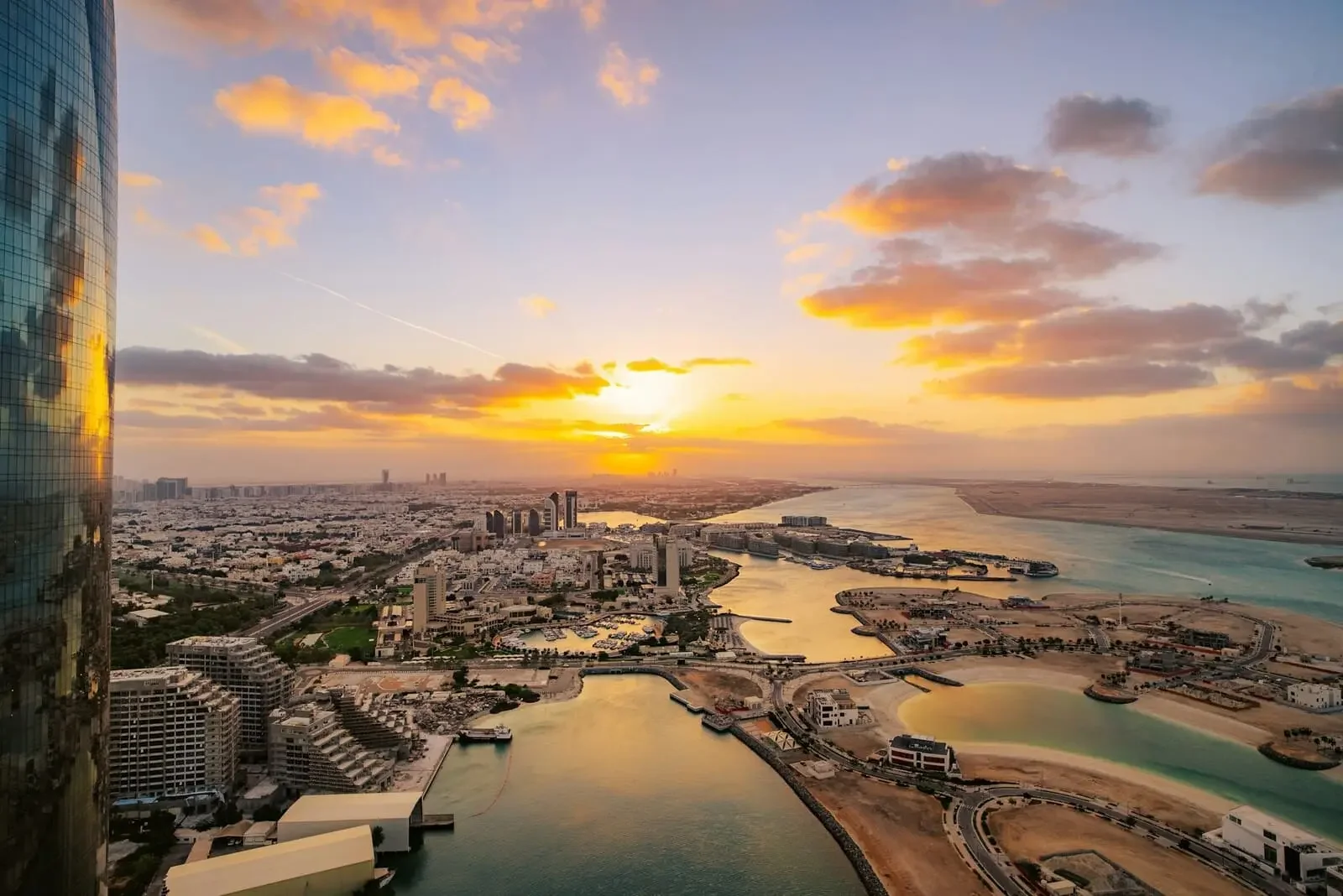
The UAE is a federation of seven emirates — each with its own regulator, its own free zones, its own real estate market, and its own business profile. Dubai dominates the narrative because it dominates the marketing. That does not make it the right answer in every case. Ras Al Khaimah wins on cost and physical infrastructure; Abu Dhabi is the global leader in crypto regulation and offers a more stable real estate market. Below is a full comparison — no marketing, just data.
| Aspect | Dubai | Abu Dhabi | Ras Al Khaimah |
|---|---|---|---|
| Free zone licence cost | AED 15–25k+ / year | From ~USD 15k / year (ADGM) | AED 5.5–11.5k / year |
| Specialisation | Services, trade, fintech, lifestyle | Crypto, finance, asset management | Logistics, manufacturing, physical e-commerce |
| Crypto regulation | VARA (Dubai) | ADGM/FSRA — global leader | No specialisation |
| Unique catalyst | Global brand recognition | First global crypto licence (Binance/ADGM) | Wynn Al Marjan — Q1 2027 |
| Family cost of living | High | Higher than Dubai in some segments | Lower than Dubai |
Ras Al Khaimah — Affordable Free Zone, Logistics, and the Casino Effect
RAKEZ: The Most Affordable Serious Free Zone in the UAE
Ras Al Khaimah Economic Zone (RAKEZ) is one of the cheapest company registration options in the entire UAE. Licences start from approximately AED 5,500–11,500 per year (approx. EUR 1,400–3,100) — well below mid-range Dubai free zones, where a comparable licence costs AED 15,000–25,000.
RAKEZ has four separate parks:
| Park | Specialisation |
|---|---|
| Business Park | Services, consulting, trade |
| Technology Park | Technology, IT, media |
| Industrial Park | Manufacturing, warehousing, logistics, processing |
| Academy Zone | Education and training |
The Industrial Park is what sets RAK furthest apart from Dubai. If your business has a physical component — warehouse-based e-commerce, manufacturing, import/export, logistics — RAK offers infrastructure that Dubai does not match at these price points. Over 19,000 new companies registered with RAKEZ in 2025.
Wynn Al Marjan — The UAE's First Casino and the Gulf's Largest of Its Kind
The Wynn resort on the artificial Al Marjan Island is a USD 5.1 billion investment and the first legal casino in the UAE — and the largest entertainment development of its kind in the Gulf region — with an officially confirmed opening in Q1 2027. The historical precedent is Marina Bay Sands in Singapore, which produced a documented real estate impact on surrounding districts.
The key question: will the regional conflict delay this trajectory? The project is proceeding on schedule as of today. But an investor positioning around the Wynn effect must factor in that unlocking tourist demand also depends on regional stabilisation.
Who RAK Makes Sense For
- Entrepreneurs with logistics, warehouse-based e-commerce, or manufacturing businesses
- Anyone looking for the most affordable serious free zone in the UAE with proper legal foundations
- Real estate investors with a 3–5 year minimum horizon and clear-eyed awareness of short-term risk
- Those who do not need a Dubai address but do need functionality at a competitive price
Abu Dhabi — Crypto Hub, Resilient Market, and an Irreplaceable Licence
ADGM: The World's First Seriously Regulated Crypto Jurisdiction
Abu Dhabi Global Market (ADGM) is a financial free zone on Al Maryah Island, regulated directly by the FSRA (Financial Services Regulatory Authority).
In December 2025, ADGM did something no regulator had done before: Binance received a global licence under the FSRA/ADGM framework — covering exchange, clearing & custody, and OTC trading through three separately licensed entities. This makes ADGM the only jurisdiction where a comprehensive, globally recognised crypto operating licence can be obtained. ADGM recorded over 12,000 active licences in 2025.
Entry costs are higher than Dubai or RAK: ADGM licences start from approximately USD 15,000 per year — but this is a different tier of product. For the full picture on crypto regulation in the UAE, including the VARA vs ADGM distinction, see the article on crypto and VARA in the UAE.
Who Abu Dhabi Makes Sense For
- Crypto businesses seeking a globally recognised regulatory framework (ADGM/FSRA)
- Family offices and asset managers with financial or digital asset holdings
- Real estate investors seeking stability rather than Dubai's more volatile, sentiment-driven market
- Private banking and fintech firms needing a licence recognised by global counterparties
UAE Real Estate in 2026 — Context Without Which No Number Makes Sense
The regional conflict struck the market at the worst possible moment: January 2026 was the highest single month in Dubai's entire history — AED 72.4 billion in transactions, +63% year-on-year, 22,108 deals. February sustained the pace: AED 60.6 billion, +18% YoY. The DFM Real Estate Index peaked at 16,910 points — then the conflict hit at the market's absolute apex.
A second, independent factor was already building: structural oversupply accumulated between 2022 and 2024, when prices rose 60–75% and approximately 385,000 units entered the construction pipeline. Effective deliveries in 2026 alone are estimated at 60,000–80,000 units. This factor operates regardless of when the conflict resolves and will continue to pressure prices and rents for the next 2–3 years.
An important methodological note: When DLD published Q1 2026 data — AED 252 billion, a record quarter, +31% YoY — it sounded like strong news. It was technically accurate but analytically misleading: it aggregated a record January, a near-record February, and a conflict-driven collapse in March. For an investor making a decision in mid-2026, the relevant data is March and April — not the quarterly aggregate.
Dubai: Correcting From a Peak, Not a Trough
Data for March and April 2026:
| Indicator | Value | Context |
|---|---|---|
| ValuStrat VPI March 2026 | –5.9% MoM | First monthly decline since 2020 |
| Transaction value March | –12.6% to –20% YoY | AED 37–53 billion |
| Active asking-price reductions (April) | 2,510 listings | Average –6.4% |
| Downtown YTD | –8.6% | Cumulative asking-price reductions |
| Palm Jumeirah YTD | –10.5% | Largest waterfront correction |
| Dubai Marina YTD | –8.8% |
One important distinction: the DFM Real Estate Index fell ~30% from its peak — but that is a listed developer equity index, not a physical property price index. Emaar Q1 2026: revenue +23% YoY, net profit +49% YoY. Developer fundamentals have not deteriorated in proportion to the equity selloff.
Three Scenarios for 2026–2028
| Scenario | Description | Price correction | Probability |
|---|---|---|---|
| A — Rapid Resolution (Q3 2026) | Volumes recover to within 5% of 2025; DFM recovers 50–60% of losses | –5–8% | Low–moderate |
| B — Prolonged Conflict (Base Case) | De-escalation H1 2027; rents soften –8–12%; off-plan default rate rises | –10–20% by end 2027 | Moderate–high |
| C — Escalation (Tail Risk) | Significant expat outflow; recovery 5–7 years minimum | –25–40% over 2–3 years | Low |
Fitch Ratings: "prices will not fall more than 15%." Historical analogy: the 2008–2011 crisis produced –37% peak-to-trough, with full price recovery only in February 2024.
Most exposed segments: land plots (–9.1% average asking-price reduction, no rental income, worst liquidity), off-plan from unproven developers, peripheral locations with supply overhang.
Relatively resilient segments: rental properties in JVC/Sports City (gross yield 7–8.4%), secondary market in Business Bay and Dubai Marina, established communities with owner-occupier demand.
Ras Al Khaimah: Wynn Momentum vs. Geopolitical Pause
RAK entered 2026 with strong data: apartment prices up +13.4% YoY in 2025, though transaction volumes fell –24% — the market was already pricing in risk before the conflict. Following the outbreak of regional hostilities, foreign investor sentiment visibly paused.
An honest assessment: the long-term structural case (RAKEZ, Wynn effect, lower entry point vs Dubai) remains intact. Near-term, the market is suspended between genuine momentum and geopolitical uncertainty. Anyone buying in RAK now should do so on a 3–5 year minimum horizon with a clear understanding that unlocking tourist demand around Wynn also depends on regional stabilisation.
Abu Dhabi: Two Different Data Pictures — Read Both
Abu Dhabi is widely described as "more resilient" than Dubai — and that is true, but only half the picture.
Picture one — closed transactions: ValuStrat Q1 2026 VPI: +17.8% YoY. Closed transaction data lags sentiment by 3–9 months — it reflects contracts signed before or immediately after the conflict began.
Picture two — the asking-price market (April 2026):
| District | Active reductions | Average reduction | Total value (AED) |
|---|---|---|---|
| Saadiyat Island | 174 | –7.3% | 111.0M |
| Yas Island | 231 | –6.4% | 58.3M |
| Al Reem Island | 204 | –6.8% | 49.2M |
| Al Hudayriat | 74 | –5.5% | 42.0M |
| Al Raha Beach | 38 | –6.6% | 8.7M |
Source: LuxuryPriceDrops, April 2026 — asking prices on active listings, not closed transactions.
This is not a contradiction with ValuStrat — it is a lag. The asking-price market leads closed transactions by several months. The takeaway for investors: do not negotiate from the asking price. Pull the last 90 days of DLD closed transactions in the same location before making an offer.
Dubai vs. Global Prime Markets
Even after the current correction, Dubai remains the most affordable prime market globally and the highest-yielding among major financial centres.
| Market | Prime price (USD/sqft) | Gross yield | Capital gains tax | Income tax on rent |
|---|---|---|---|---|
| Dubai | $500–900 | 5.5–8.0% | 0% | 0% |
| London | $1,500–3,000 | 3.0–4.5% | 18–28% | Up to 45% |
| Singapore | $2,000–3,500 | 2.5–3.5% | 0%* | Up to 22% |
| Miami | $800–1,500 | 4.0–5.5% | 0–20% | Up to 37% |
| New York | $1,500–3,000 | 2.5–4.0% | 15–37% | Up to 37% |
| Paris | $1,200–2,500 | 2.5–3.5% | ~36.2% | Up to 45% |
Singapore: ABSD up to 60% for foreign buyers at purchase.
The structural advantages of UAE — 0% income tax on rental income, 0% capital gains tax, 4% DLD fee at purchase — have not changed as a result of the conflict. What has changed is the short-term geopolitical risk premium. For the broader cost picture: what UAE relocation actually costs and when 0% tax actually works.
In short: The UAE is not one market. The choice of emirate should follow your business profile, asset structure, and time horizon — not which one has the best Instagram presence. Dubai is correcting from a record peak, Abu Dhabi is holding up better but is not immune, and RAK is suspended between two parallel catalysts. All of this is information worth factoring in before you sign anything.
Frequently Asked Questions
How does RAKEZ differ from Dubai free zones? RAKEZ licences start from AED 5,500–11,500 per year — well below mid-range Dubai (AED 15,000–25,000). The key differentiator is the Industrial Park for logistics and manufacturing. Full cost breakdown for all free zone options in the article on free zone and mainland structures.
What is ADGM and why does Abu Dhabi lead in crypto? ADGM is regulated by FSRA — the only jurisdiction with a comprehensive global crypto licence (Binance, December 2025). More detail in the article on crypto and VARA in the UAE.
Is Wynn Al Marjan a sound real estate investment? A 3–5 year minimum horizon bet. Long-term fundamentals are strong (Marina Bay Sands precedent), but short-term geopolitical uncertainty has paused sentiment. Not suitable for anyone with a short horizon or a liquidity requirement.
Why was Dubai's Q1 2026 a record quarter if the market is correcting? Q1 aggregates a record January, a near-record February, and a conflict-driven collapse in March. The quarterly average is analytically misleading. The relevant data for a mid-2026 decision is March and April: asking-price reductions averaging –6.4% across 2,510 active listings.
Which emirate makes sense for a logistics business? RAK and the RAKEZ Industrial Park — lower costs, dedicated infrastructure. Dubai wins on visibility and B2B ecosystem but cannot match RAK on price or physical infrastructure for operationally intensive businesses.
Is Abu Dhabi immune to the real estate correction? More resilient than Dubai — its buyer base is more institutional and long-term. But not immune. Asking prices are correcting –6–7% in key districts (April 2026 data). Closed transactions (+17.8% YoY) reflect pre-conflict contracts and are lagged by 3–9 months.
Real estate data based on: ValuStrat VPI; LuxuryPriceDrops; DLD / Dubai Media Office; CBRE Q1 2026; Knight Frank; Fitch Ratings. Full analysis with month-by-month data available in the Meridion Bridge — Dubai Real Estate 2026 report. Content is for informational purposes only and does not constitute investment, legal, or tax advice.